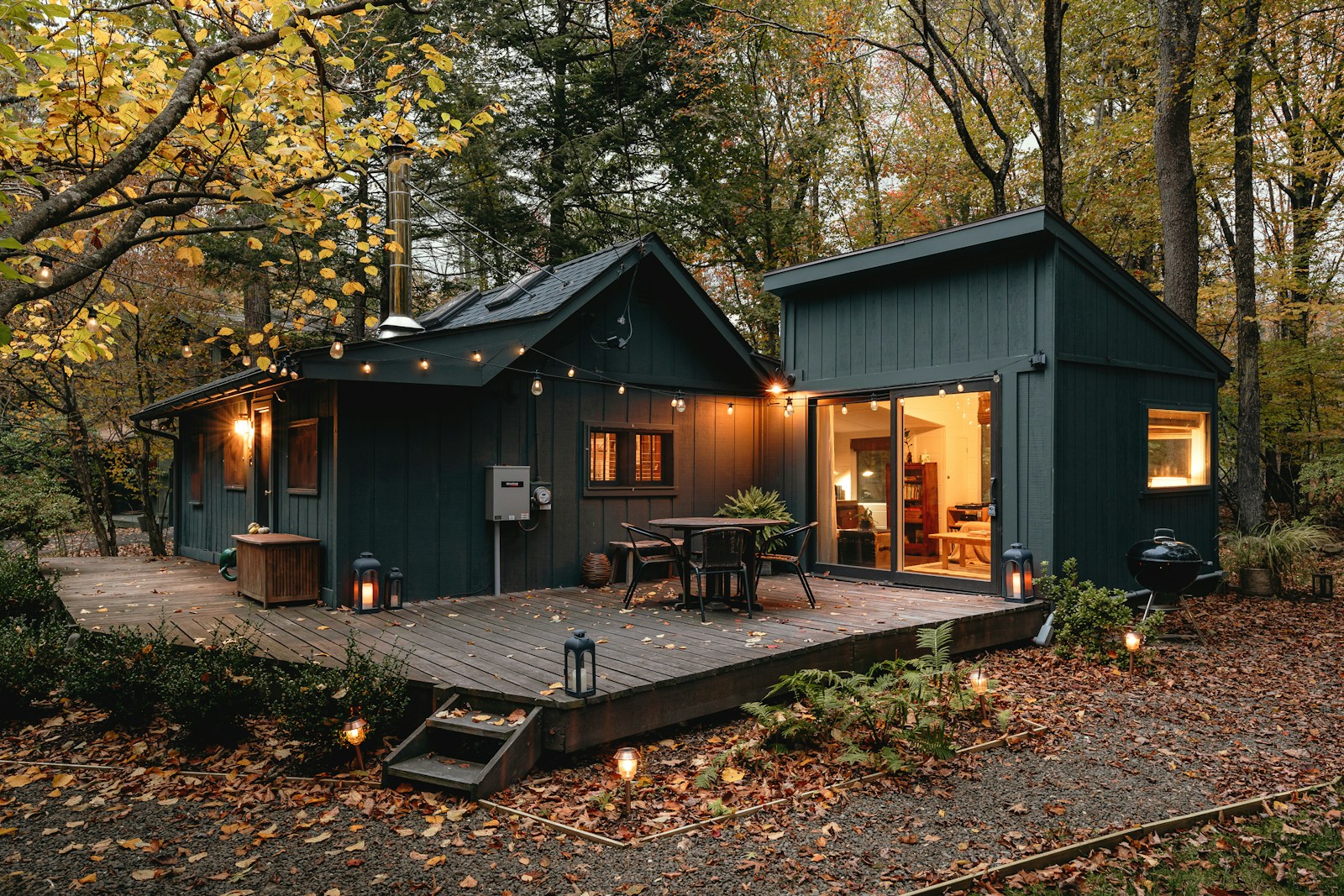
Illustrative photography · Not the modeled property
BROKEN BOW, OKLAHOMA
↗The Woodland Retreat
Purchase$500k
Annual cash flow¹$53,832
Annual gross rent¹$140k
 Build my STR plan ↗
We source your short-term rental, help you buy and launch it, and include a cost segregation study. Your CPA determines whether the resulting loss can offset your W-2 income.
The deduction reduces taxable income. Your tax savings depend on eligibility, available income and the tax rates the loss actually offsets.
Illustrative photography · Not the modeled property
Play the journey, or tap any step. See what we handle and where you take the lead.
We research the market, underwrite the property and help you build a shortlist around your goals.
Select one of the three featured markets below. Other dots show places we may research, without property projections.
Illustrative imagery · Not an actual listing
A hypothetical Broken Bow cabin with a separately funded furnishing package.
This is a modeled tax loss, not a dollar-for-dollar tax saving. Actual deductions and use of the loss depend on your facts and CPA review.
Market demandWho visits, when and why.
Property economicsRevenue, costs and downside.
Your fitBudget, owner role and CPA review.
Higher-capital hypothetical scenarios, not market forecasts or client results. Every address requires current diligence; tax eligibility is assessed separately.
Find my starting pointLook at the full investment, not just the first-year tax result. Each benefit works differently, and none is guaranteed.
Illustrative cash remaining after operating costs, financing and a capital reserve. Revenue and expenses can change.
Eligible deductions may reduce taxable income when the resulting loss is usable under the applicable rules.
Each principal payment reduces the loan balance and increases your share of the property, assuming its value holds.
The property could gain value over time. It could also stay flat or decline, so this example assumes no appreciation.
Financing is illustrative, not a lender quote: $100,000 down (20%), a $400,000 loan (80%), 7.5% fixed interest and 20-year amortization. The first 12 payments total $38,668, including $29,696 interest and $8,973 principal. Figures are rounded to whole dollars; calculations use unrounded amounts. Broken Bow assumes $140,000 annual gross revenue and $43,000 operating expenses; these are hypothetical inputs, not market forecasts. The $128,000 shorter-life acquisition allocation is 32% of the $400,000 depreciable acquisition basis. This fictional full-year illustration assumes 100% business use, no personal use, qualifying new or used assets acquired and placed in service in 2026, no election out of bonus depreciation, and a substantiated $128,000 shorter-life acquisition allocation plus $120,000 of additional qualifying furnishings with no double counting. It assumes the activity is nonpassive because the customer-use exception and a material participation test are met, sufficient basis and at-risk amounts, and no excess business loss or other deduction limit. It excludes regular building depreciation, closing-cost basis adjustments and tax treatment of advisory and acquisition-related costs; your CPA determines those items. Actual results and the study allocation differ by property. State conformity, credits, AMT and other tax interactions are not modeled. A shorter launch year changes income and costs. This is not an incremental benefit comparison against ordinary depreciation.
The $120,000 furnishings are funded separately and assumed placed in service in the same year. Purchase plus furnishings totals $620,000; modeled down payment plus furnishings requires $220,000 cash before closing, other setup and reserves. Furnishing purchases are not included in the displayed recurring annual cash flow, so initial-year cash outlays are materially greater. Tax savings are separate from operating cash flow and are not assumed to recur. The actual acquisition and setup budget requires property-specific quotes. Accelerating deductions reduces future depreciation and can trigger recapture upon sale.
The Chattanooga and Asheville cards are separate full-year hypothetical models. Chattanooga assumes a $1,000,000 purchase, $200,000 gross revenue, $70,000 operating expenses, 20% land allocation, a $256,000 shorter-life allocation (32% of its $800,000 depreciable acquisition basis), and $200,000 of separately funded qualifying furnishings and amenities; after $59,391 of modeled loan interest, the resulting first-year tax loss is $385,391. Asheville assumes a $1,100,000 purchase, $220,000 gross revenue, $80,000 operating expenses, 20% land allocation, a $281,600 shorter-life allocation (32% of its $880,000 depreciable acquisition basis), and $205,000 of separately funded qualifying furnishings and amenities; after $65,331 of modeled loan interest, the resulting loss is $411,931. Both use the same illustrative financing and tax eligibility conditions described above; acquisition allocations and qualification of separately funded items require property-specific substantiation. These costs are additional cash outlays, not included in the displayed purchase price or recurring cash flow, and actual write-offs may be lower or unavailable.
Read: IRC §469 participation and loss limits · IRC §168(k) bonus depreciation · Rental expenses, land and personal use.
Tell us about your goals. We’ll review your responses and contact you to discuss your next step.
Responses are securely submitted through Tally to Next Step. Open the form in a new tab ↗
Know the capital, your role and the risks before you buy.
We recommend at least $175,000 available for an Airbnb investment, with a property-specific budget for the down payment, furnishings, setup, closing costs and reserves.
Yes—we search around your budget, goals, preferred locations and owner role, then explain each property’s numbers and tradeoffs. You approve any offer; the site examples are hypothetical, not available or promised deals.
No experience is required; we guide the search and launch and provide tools and advice while you lead day-to-day operations. Your documented work matters for material participation—our work, vendor work and automation do not count as your hours, so have your CPA review the actual arrangement.
Financing, property selection, inspections, local approvals and setup determine the timeline, so we set milestones after the initial review but cannot promise a launch date. Revenue starts only when guests book a ready property, and positive cash flow depends on actual income, costs, debt payments and reserves.
Potentially: eligible depreciation and expenses may create a loss that offsets W-2 income if guest-use and material-participation rules are met and basis, at-risk and other limits permit it. A cost segregation study alone does not establish eligibility; your CPA determines what is deductible and usable.
Our guarantee is to help you find and purchase a short-term rental modeled to produce at least a $100,000 first-year tax write-off or your money back.